
Card #096 · Invertebrates
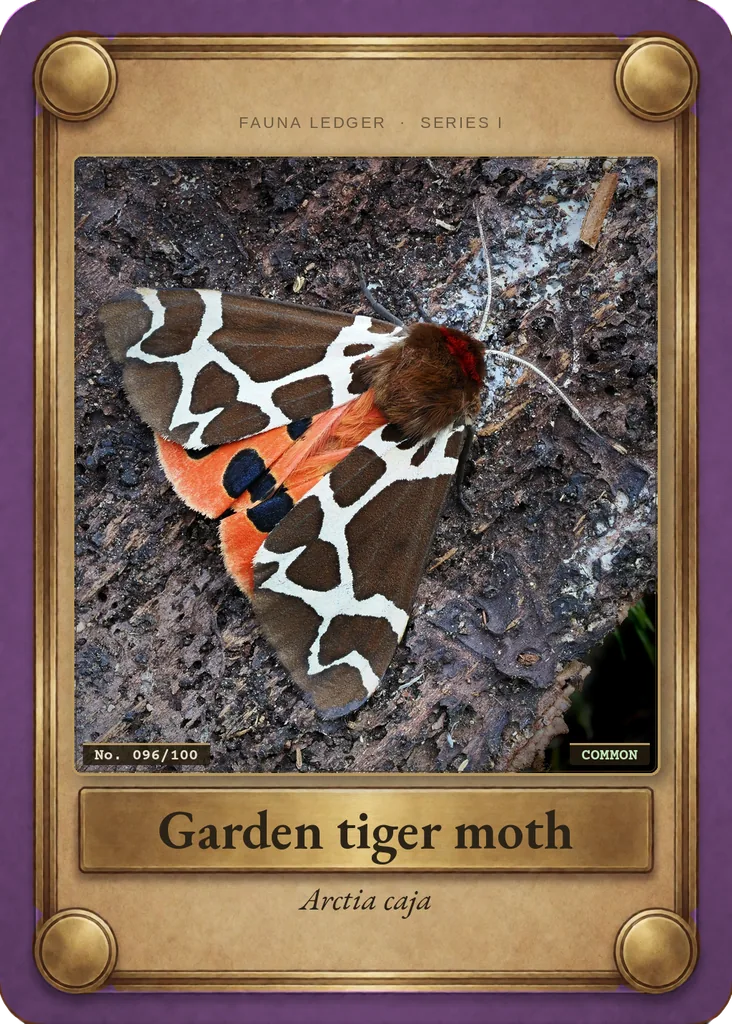
Garden tiger moth
Arctia caja
Common NE · Not Evaluated
Field notes
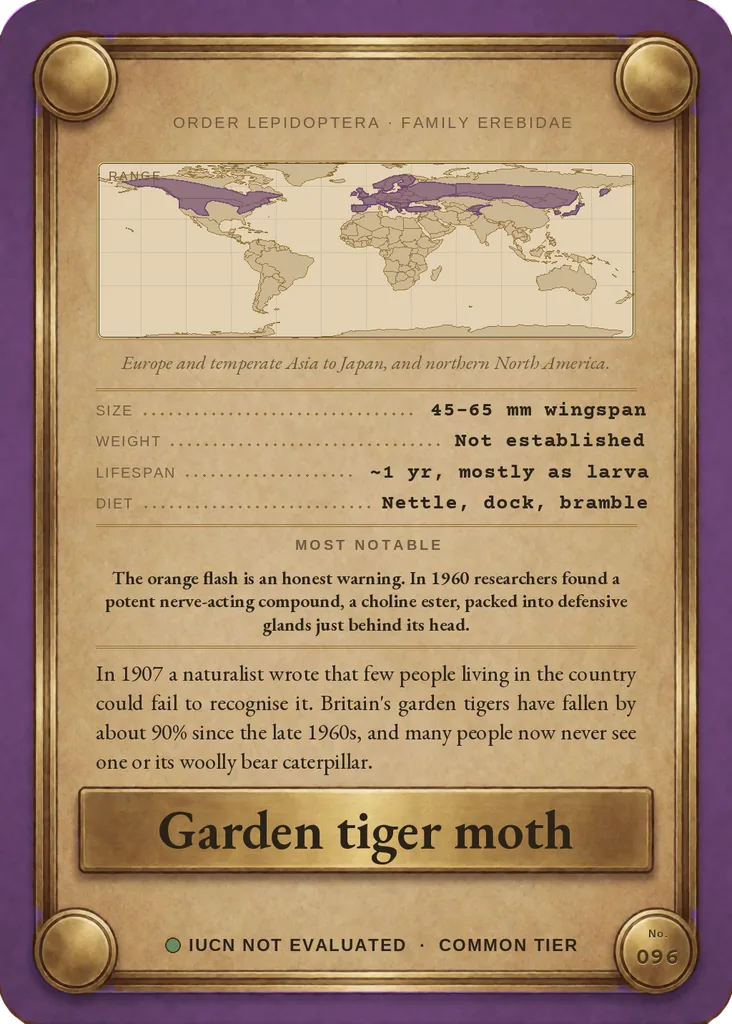
- Classification
- Order Lepidoptera · Family Erebidae
- Range
- Europe, temperate Asia to Japan, and northern North America
- Size
- 45–65 mm wingspan
- Weight
- Not established
- Lifespan
- ~1 yr, mostly as larva
- Diet
- Nettle, dock, bramble
Most Notable
The orange flash is an honest warning. In 1960 researchers found a potent nerve-acting compound, a choline ester, packed into defensive glands just behind its head.
In 1907 a naturalist wrote that few people living in the country could fail to recognise it. Britain's garden tigers have fallen by about 90% since the late 1960s, and many people now never see one or its woolly bear caterpillar.
This card reads Not Evaluated because the garden tiger has no IUCN Red List assessment at all. It is still widespread across Europe, Asia and North America, but it is on Germany's national warning list and has declined steeply in Britain.
You may read that it clicks to jam the sonar of hunting bats. Sonar jamming by a tiger moth is real, but it was shown in 2009 in a different species, the North American Bertholdia trigona. What is recorded for the garden tiger is a rasping sound people can hear, described by Miriam Rothschild and P. T. Haskell in 1966.
Its caterpillars can store plant poisons. Fed deadly nightshade in a 2023 study, they kept the atropine in their bodies.
Britain's garden tigers have changed shape as they declined. Moths caught recently have longer, narrower hindwings than museum specimens from a century ago, and less genetic diversity.
It spends most of the year as a caterpillar. The woolly bear hatches in late summer, sleeps through winter while still under a centimetre long, and flies as a moth the next summer.
Range: Europe and temperate Asia to Japan, and northern North America.