
Card #089 · Amphibians
Olm
Proteus anguinus
Rare VU · Vulnerable
Field notes
- Classification
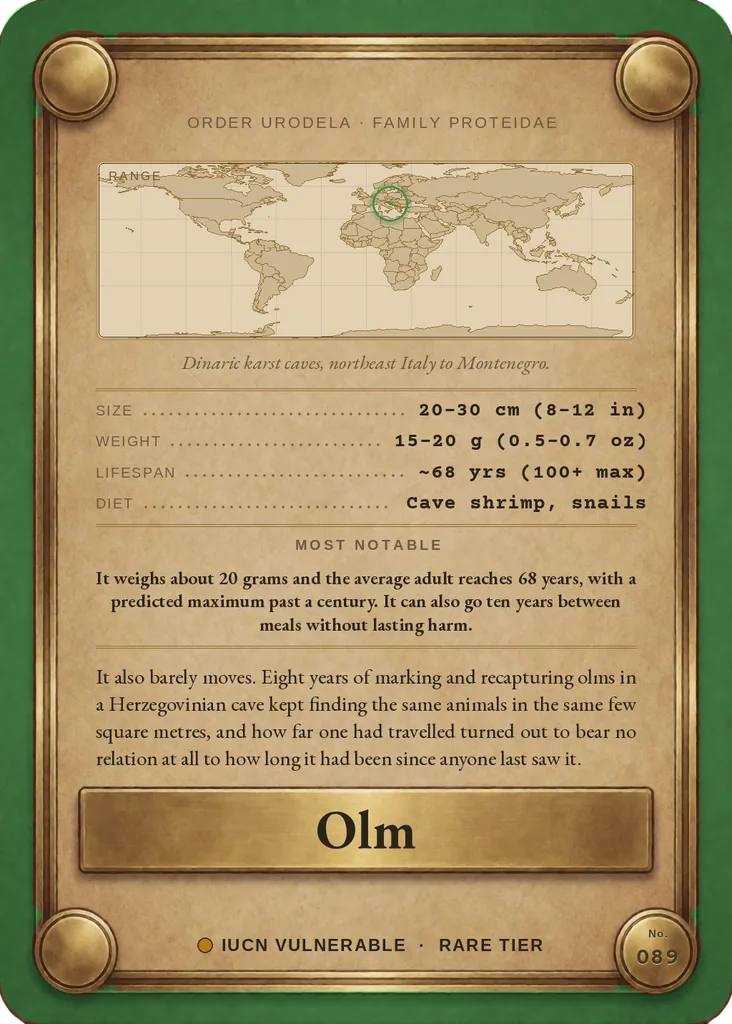
- Order Urodela · Family Proteidae
- Range
- Dinaric karst caves, northeast Italy to Montenegro
- Size
- 20–30 cm (8–12 in)
- Weight
- 15–20 g (0.5–0.7 oz)
- Lifespan
- ~68 yrs (100+ max)
- Diet
- Cave shrimp, snails
Most Notable
It weighs about 20 grams and the average adult reaches 68 years, with a predicted maximum past a century. It can also go ten years between meals without lasting harm.
It also barely moves. Eight years of marking and recapturing olms in a Herzegovinian cave kept finding the same animals in the same few square metres, and how far one had travelled turned out to bear no relation at all to how long it had been since anyone last saw it.
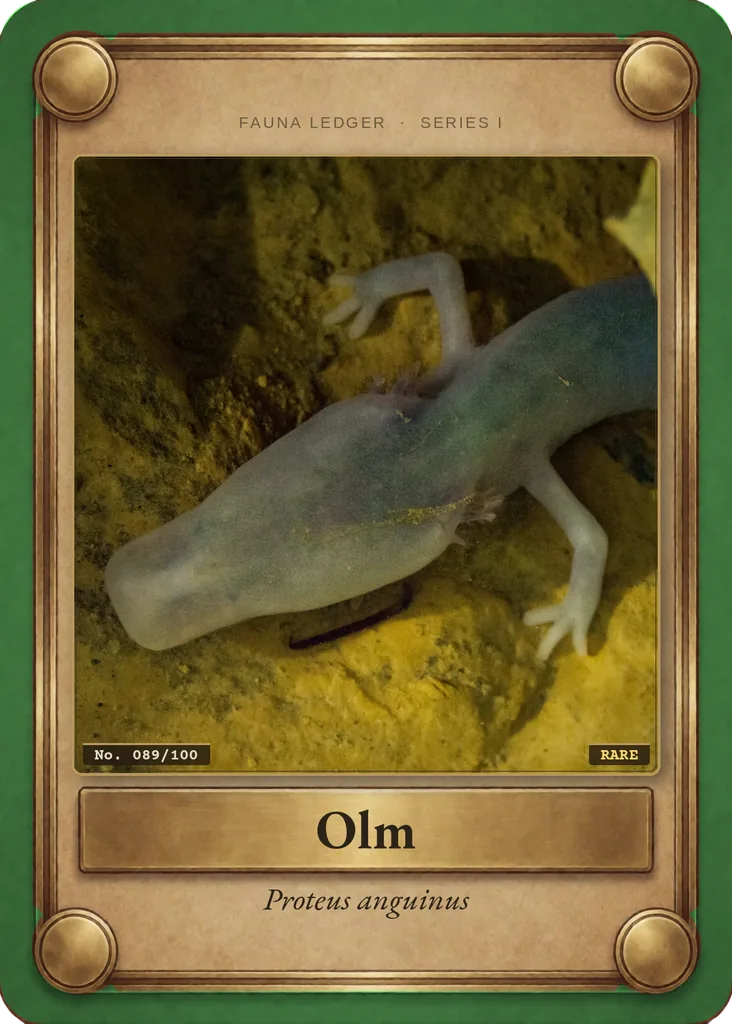
Calling it blind is not quite right, and the truth is better. Larvae grow eyes that stop developing and are then covered over by skin, and the adult still senses light through its skin. Darwin used it as his example of an organ reduced by disuse.
Slovenians called them baby dragons. Olms flushed out of the karst by floods were taken for the young of something much larger living underground, which is a reasonable guess if a pale limbed thing washes out of a cave mouth.
The lifespan figure came from a lab that has been running for over fifty years. The CNRS underground laboratory at Moulis keeps a colony of around 400 animals, and the animal in this photograph is one of them. There is no good way to photograph a wild olm.
There is a black one. A pigmented, eyed subspecies described from a single small area of southeastern Slovenia in 1986 looks so unlike the pale form that it took a while to accept it was the same species.
Range: Dinaric karst caves, northeast Italy to Montenegro.