
Card #085 · Amphibians
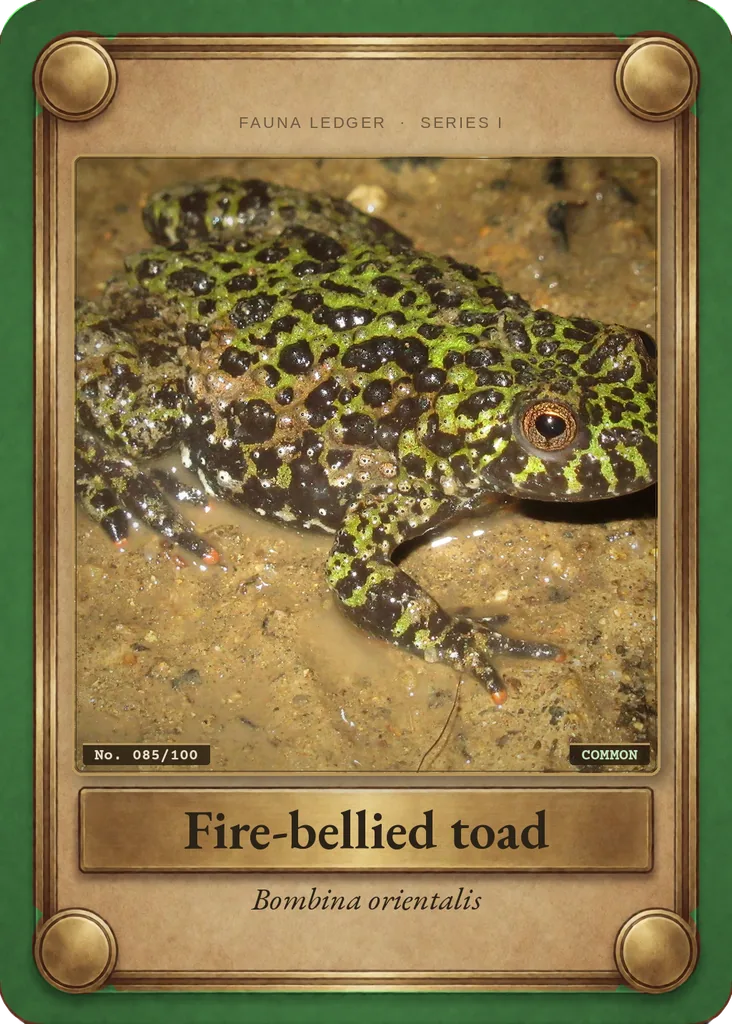
Oriental fire-bellied toad
Bombina orientalis
Common LC · Least Concern
Field notes
- Classification
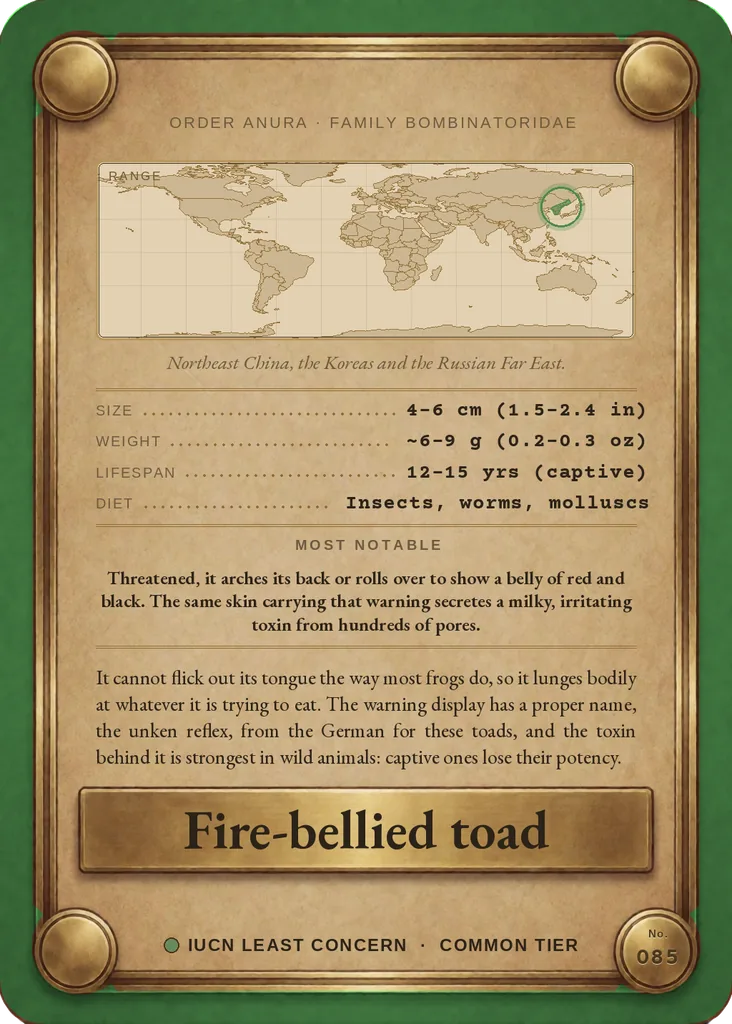
- Order Anura · Family Bombinatoridae
- Range
- Northeast China, the Korean peninsula and the Russian Far East
- Size
- 4–6 cm (1.5–2.4 in)
- Weight
- ~6–9 g (0.2–0.3 oz)
- Lifespan
- 12–15 yrs (captive)
- Diet
- Insects, worms, molluscs
Most Notable
Threatened, it arches its back or rolls over to show a belly of red and black. The same skin carrying that warning secretes a milky, irritating toxin from hundreds of pores.
It cannot flick out its tongue the way most frogs do, so it lunges bodily at whatever it is trying to eat. The warning display has a proper name, the unken reflex, from the German for these toads, and the toxin behind it is strongest in wild animals: captive ones lose their potency.
The belly is not always red. It runs from yellow through orange to a deep red, always broken up with dark blotches, and the pattern is individual enough to tell animals apart.
The toxin includes bombesin, a peptide first found in these toads that turned out to act on gastric function in mammals and is now a standard tool in physiology.
Least Concern is not the same as safe. The listing rests on a wide range and a large population, but the species is declining through habitat loss, and the small Russian population is collected for traditional medicine.
The lifespan on the card is a captive figure. These are unusually long-lived little toads, 12 to 15 years in care and reportedly up to 20, but nobody has established what they manage in the wild.
Range: Northeast China, the Koreas and the Russian Far East.