
Card #084 · Amphibians
Surinam toad
Pipa pipa
Common LC · Least Concern
Field notes
- Classification
- Order Anura · Family Pipidae
- Range
- Amazon and Orinoco basins, tropical South America
- Size
- 10–17 cm (4–7 in)
- Weight
- ~100–200 g (4–7 oz)
- Lifespan
- ~8 yrs (captive)
- Diet
- Fish, crustaceans, insects
Most Notable
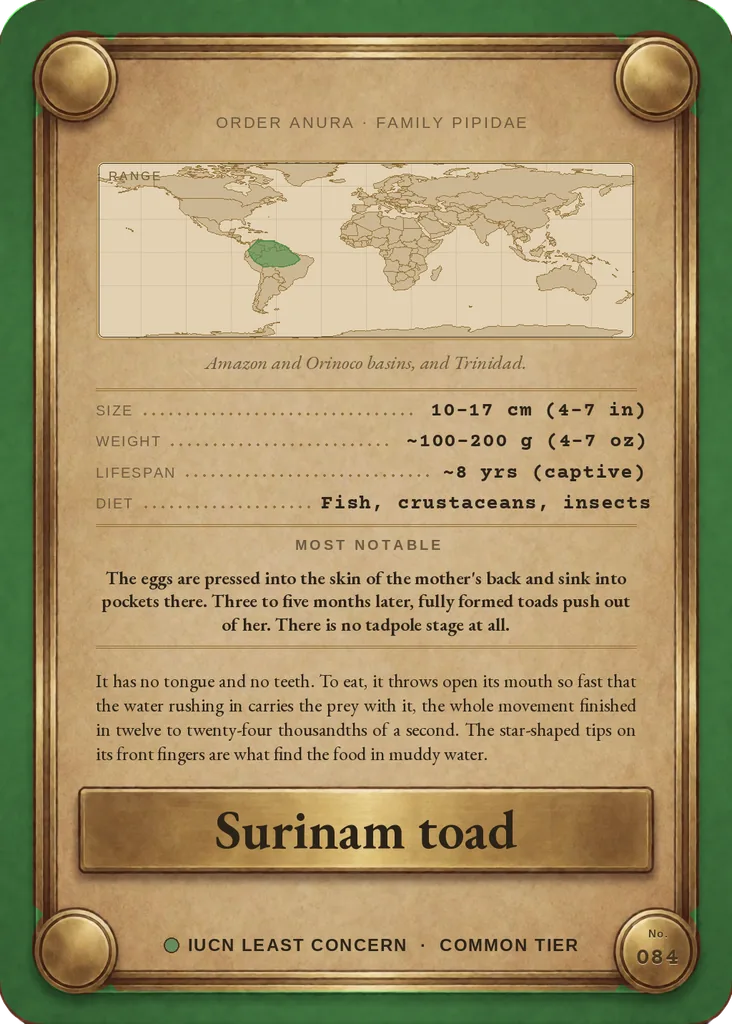
The eggs are pressed into the skin of the mother's back and sink into pockets there. Three to five months later, fully formed toads push out of her. There is no tadpole stage at all.
It has no tongue and no teeth. To eat, it throws open its mouth so fast that the water rushing in carries the prey with it, the whole movement finished in twelve to twenty-four thousandths of a second. The star-shaped tips on its front fingers are what find the food in muddy water.
Nothing about the birth is metaphorical. The male presses the fertilised eggs onto the female's back during mating, the skin grows over them, and the young develop in those pockets until they push out as complete little toads.
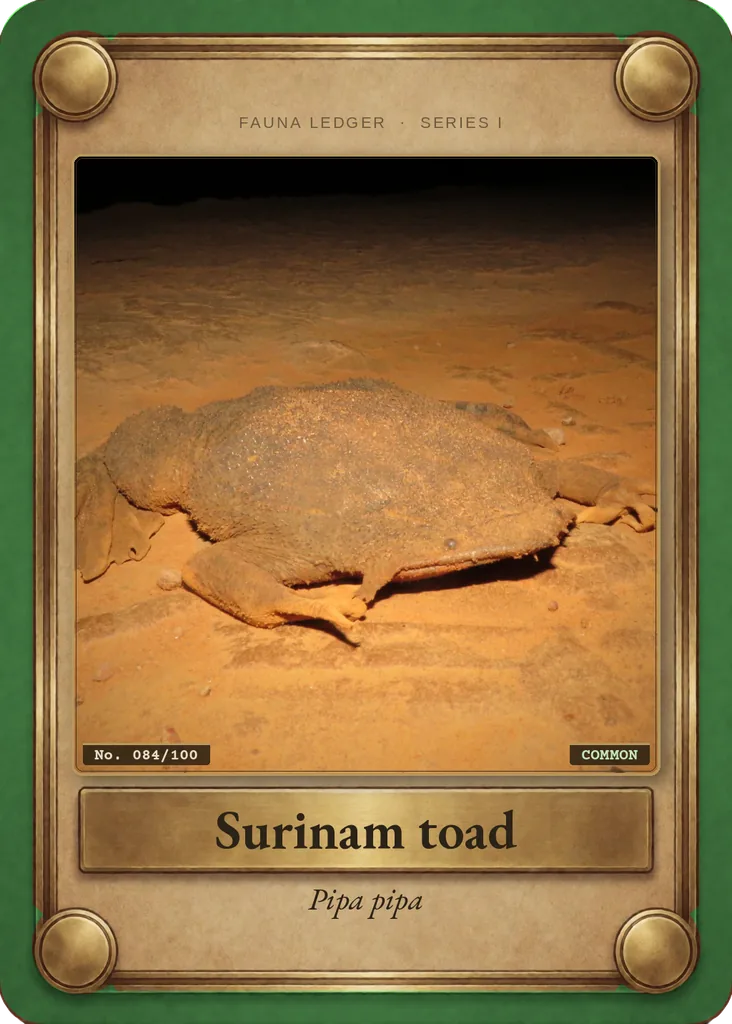
It is built like something run over. The body is almost perfectly flat and the head is a broad triangle, which is camouflage: in murky water at the bottom of a river it reads as a dead leaf.
The male sings underwater by clicking, a sound made with a bony structure in the larynx rather than by moving air the way a calling frog does.
This photograph is a wild animal at night in Manuripi, Bolivia, and it is flash-lit and orange because of it. Almost every other available image of this species is a museum specimen.
Range: Amazon and Orinoco basins, and Trinidad.