
Card #080 · Fish
Great white shark
Carcharodon carcharias
Rare VU · Vulnerable

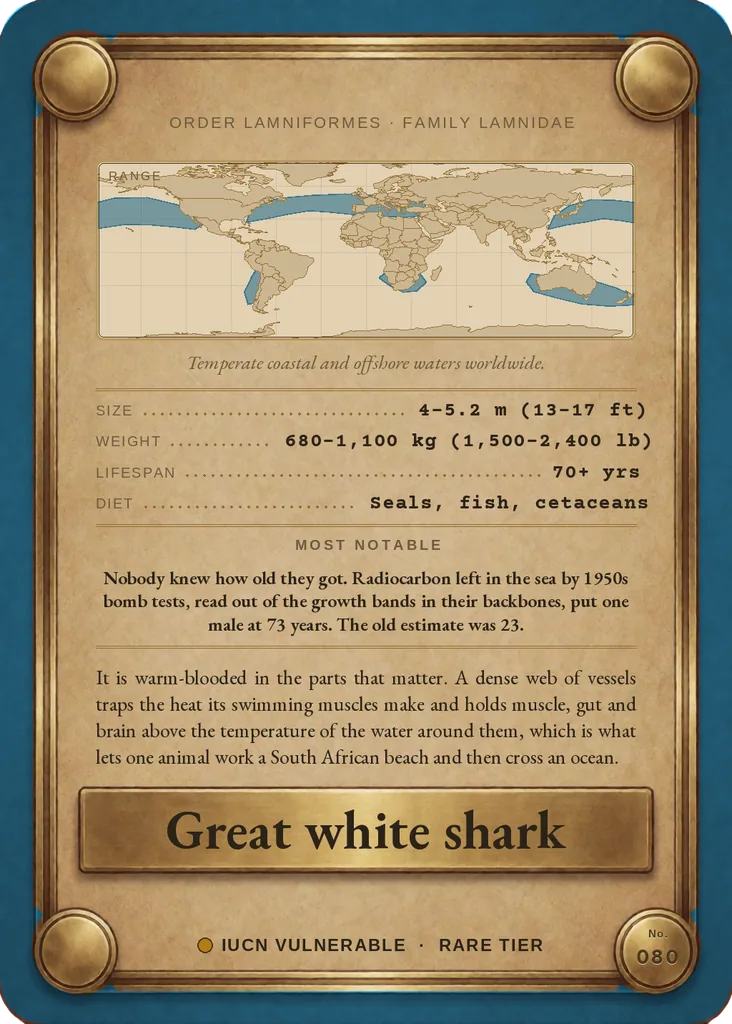
Field notes
- Classification
- Order Lamniformes · Family Lamnidae
- Range
- Temperate coastal and offshore waters worldwide
- Size
- 4–5.2 m (13–17 ft)
- Weight
- 680–1,100 kg (1,500–2,400 lb)
- Lifespan
- 70+ yrs
- Diet
- Seals, fish, cetaceans
Most Notable
Nobody knew how old they got. Radiocarbon left in the sea by 1950s bomb tests, read out of the growth bands in their backbones, put one male at 73 years. The old estimate was 23.
It is warm-blooded in the parts that matter. A dense web of vessels traps the heat its swimming muscles make and holds muscle, gut and brain above the temperature of the water around them, which is what lets one animal work a South African beach and then cross an ocean.
You will read that a great white can smell a single drop of blood in 25 gallons of water, or from a mile away. Neither figure traces to a measurement, and the mile is ruled out by how quickly a scent plume dilutes. The real sense of smell is very good without the folklore.
The ageing study worked because of the bomb tests. Atmospheric nuclear testing in the 1950s and 60s loaded the ocean with carbon-14, and that pulse is preserved in the bands of a shark's vertebrae, giving a dated ruler to read a lifetime against.
It really does have an electrical sense. The ampullae of Lorenzini, the pores across its snout, detect the faint fields that muscle and nerve activity give off, which works at close range when sight and smell have run out.
Vulnerable, and slow to replace itself. A fish that takes decades to mature and lives past 70 cannot absorb much fishing pressure, which is the whole reason the longevity finding mattered to managers and not just to the curious.
Range: Temperate coastal and offshore waters worldwide.