
Card #079 · Fish
Atlantic salmon
Salmo salar
Uncommon NT · Near Threatened
Field notes
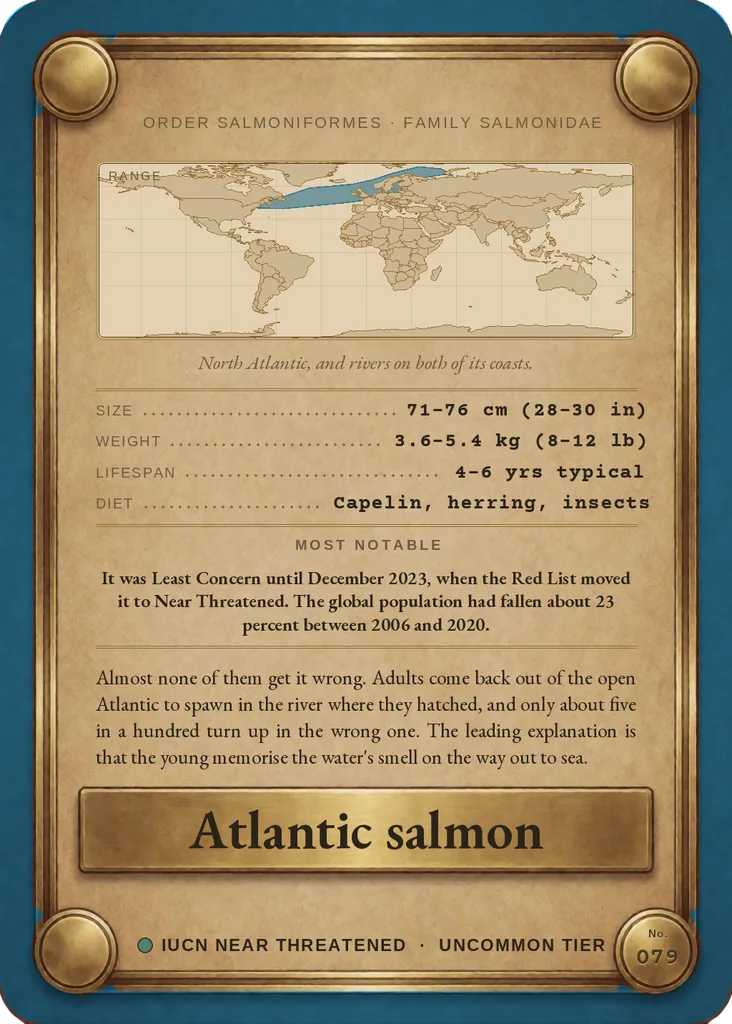
- Classification
- Order Salmoniformes · Family Salmonidae
- Range
- North Atlantic, and rivers of Europe and North America
- Size
- 71–76 cm (28–30 in)
- Weight
- 3.6–5.4 kg (8–12 lb)
- Lifespan
- 4–6 yrs typical
- Diet
- Capelin, herring, insects
Most Notable
It was Least Concern until December 2023, when the Red List moved it to Near Threatened. The global population had fallen about 23 percent between 2006 and 2020.
Almost none of them get it wrong. Adults come back out of the open Atlantic to spawn in the river where they hatched, and only about five in a hundred turn up in the wrong one. The leading explanation is that the young memorise the water's smell on the way out to sea.
The global listing is the kind one. Great Britain assesses its own Atlantic salmon as Endangered, and the Red List's Near Threatened is a worldwide average laid over rivers that are in very different states.
It does not have to die to spawn. Pacific salmon spawn once and are finished, but between five and ten percent of Atlantic salmon recover, return to the sea and come back to do it again.
The record is old and large. A fish of 49.44 kg was netted in Scotland in 1960, and the longest on record, 160.65 cm, came from Norway in 1925.
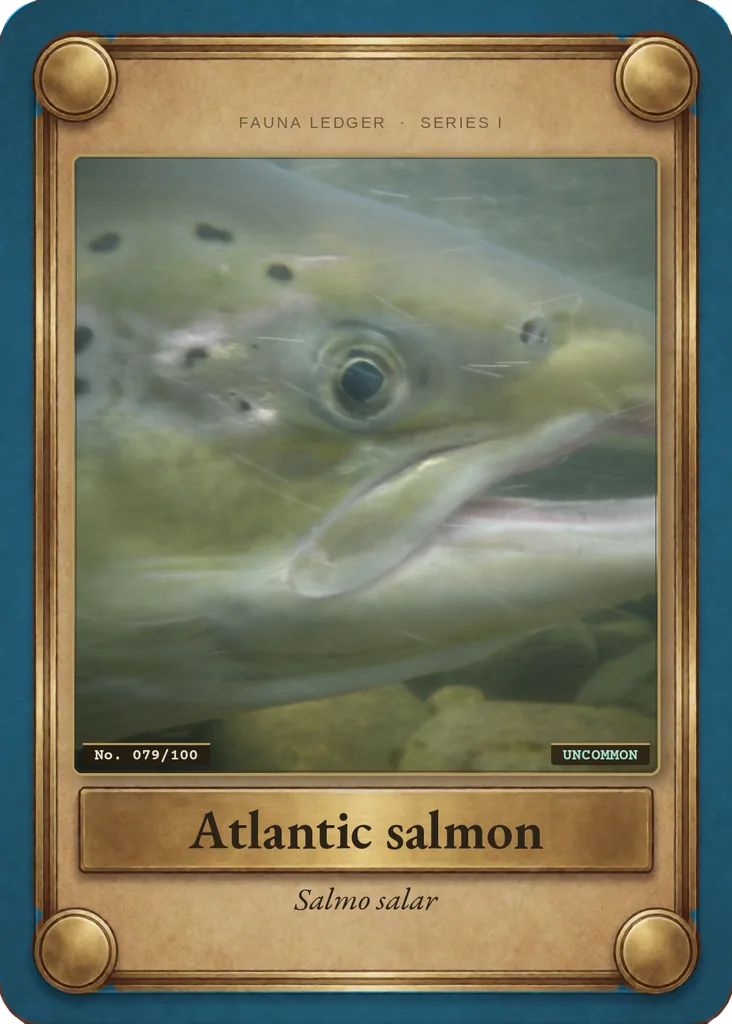
Photographing a wild one honestly is surprisingly hard. Most available images are farmed fish on ice, aquarium glass, survey juveniles beside a ruler, or an angler's catch. This is an unhandled wild fish in the Laerdal river in Norway, which is why it is soft.
Range: North Atlantic, and rivers on both of its coasts.