
Card #071 · Fish
Clownfish
Amphiprion ocellaris
Common LC · Least Concern
Field notes
- Classification
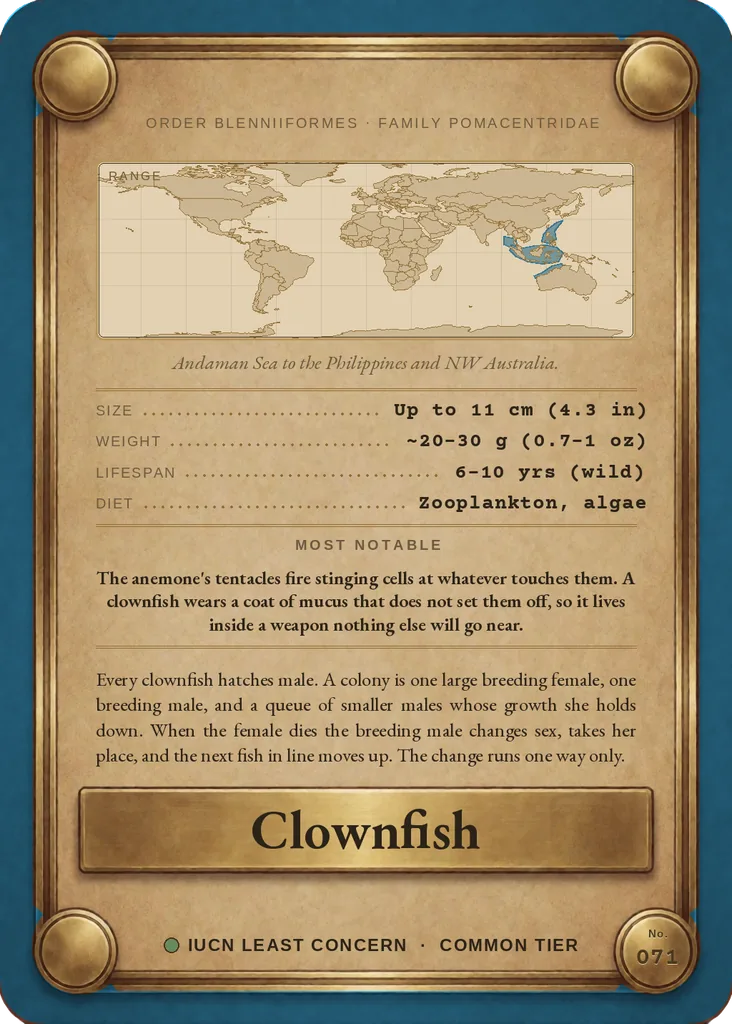
- Order Blenniiformes · Family Pomacentridae
- Range
- Eastern Indian Ocean and western Pacific reefs
- Size
- Up to 11 cm (4.3 in)
- Weight
- ~20–30 g (0.7–1 oz)
- Lifespan
- 6–10 yrs (wild)
- Diet
- Zooplankton, algae
Most Notable
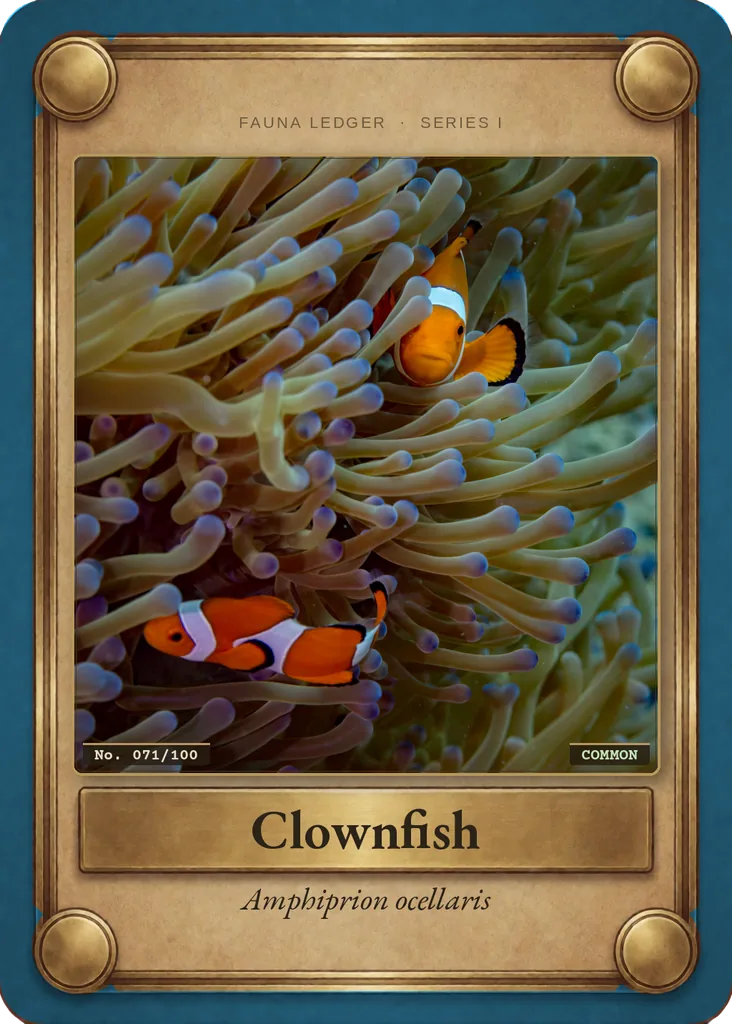
The anemone's tentacles fire stinging cells at whatever touches them. A clownfish wears a coat of mucus that does not set them off, so it lives inside a weapon nothing else will go near.
Every clownfish hatches male. A colony is one large breeding female, one breeding male, and a queue of smaller males whose growth she holds down. When the female dies the breeding male changes sex, takes her place, and the next fish in line moves up. The change runs one way only.
The anemone is not a shelter it borrows, it is the whole territory. A clownfish rarely strays more than a metre from its host, and away from one it does not last long. The anemone gets something back: the fish drives off butterflyfish that would nip its tentacles, and its waste fertilises the algae living in the anemone's tissue.
The mucus coat is acquired, not innate. A settling fish touches the tentacles briefly and repeatedly over hours, and the coat it builds up stops the stinging cells from firing.
This is the fish from the film, and the film had an effect nobody wanted: demand for wild-caught clownfish rose sharply afterwards. Most clownfish sold today are captive bred, which has taken much of that pressure back off the reef.
For a reef fish this small they are remarkably long lived. A study of the close relative Amphiprion percula estimated individuals could reach around 30 years, and clownfishes are now studied as a model for ageing.
Range: Andaman Sea to the Philippines and NW Australia.