
Card #049 · Birds
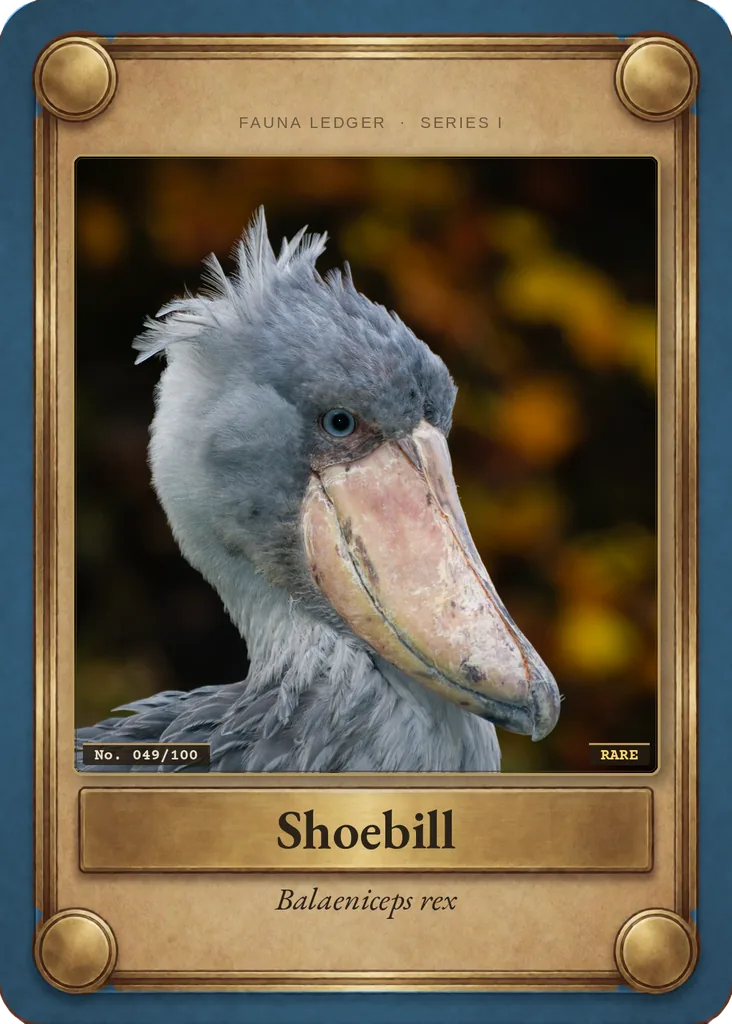
Shoebill
Balaeniceps rex
Rare VU · Vulnerable
Field notes
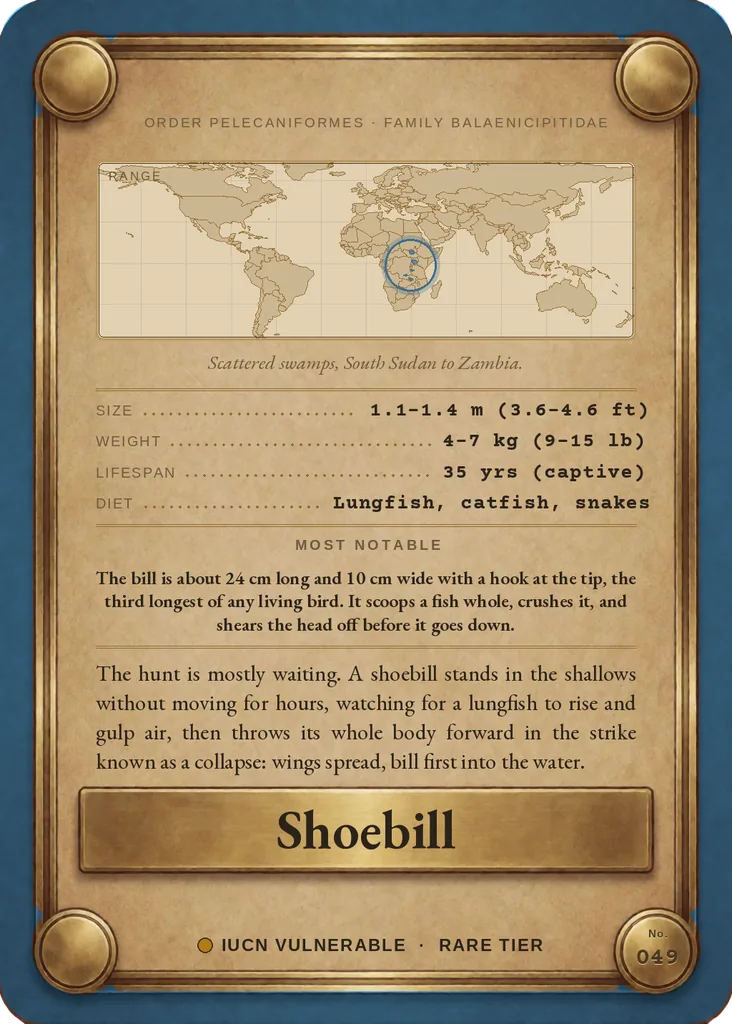
- Classification
- Order Pelecaniformes · Family Balaenicipitidae
- Range
- Swamps of central and east Africa
- Size
- 1.1–1.4 m (3.6–4.6 ft)
- Weight
- 4–7 kg (9–15 lb)
- Lifespan
- 35 yrs (captive)
- Diet
- Lungfish, catfish, snakes
Most Notable
The bill is about 24 cm long and 10 cm wide with a hook at the tip, the third longest of any living bird. It scoops a fish whole, crushes it, and shears the head off before it goes down.
The hunt is mostly waiting. A shoebill stands in the shallows without moving for hours, watching for a lungfish to rise and gulp air, then throws its whole body forward in the strike known as a collapse: wings spread, bill first into the water.
It is not a stork. The name says otherwise and so did the textbooks for a century, but DNA moved the shoebill into Pelecaniformes, alongside the pelicans. Its closest living relative is the hamerkop, a small brown bird of the same African wetlands.
The wings span 2.3 to 2.6 m and beat about 150 times a minute, one of the slowest wingbeats measured in any bird.
Two eggs are laid a few days apart, and it is rare for more than one chick to leave the nest. The second egg is insurance: the older chick takes the food and drives off its sibling. In the heat the parents carry water up in the bill and pour it over the nest.
Between 3,300 and 5,300 mature birds are left, most of them in the Sudd of South Sudan. Drained wetlands, disturbance at the nest and the capture of chicks for the live-bird trade are what is taking them.
Range: Scattered swamps, South Sudan to Zambia.