
Card #017 · Mammals
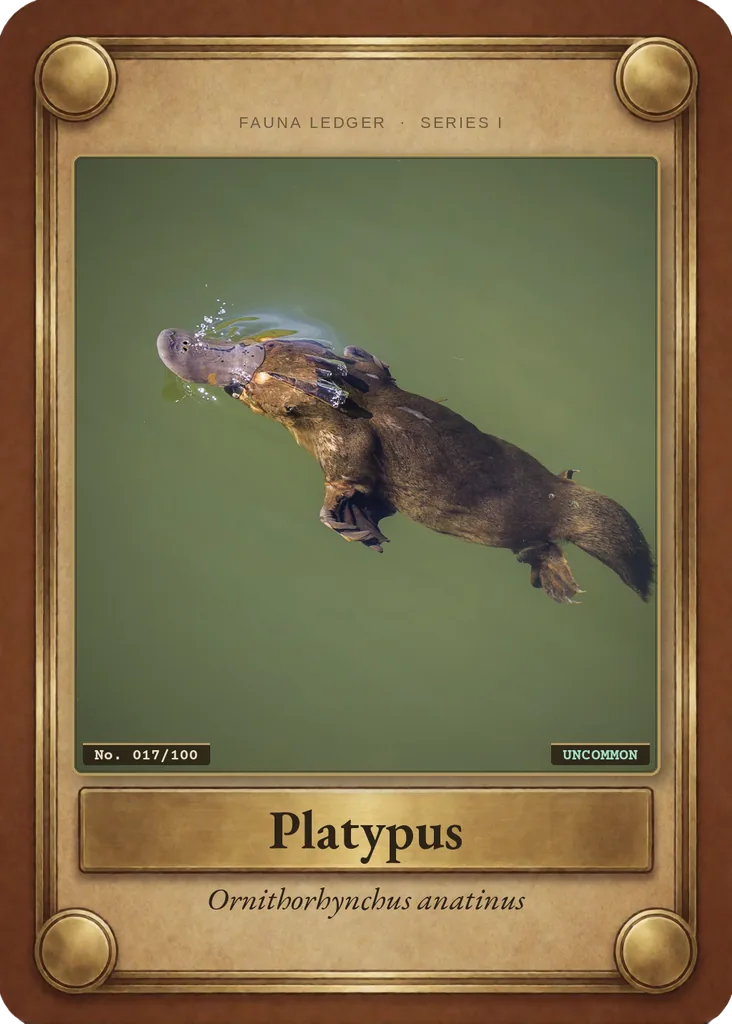
Platypus
Ornithorhynchus anatinus
Uncommon NT · Near Threatened
Field notes
- Classification
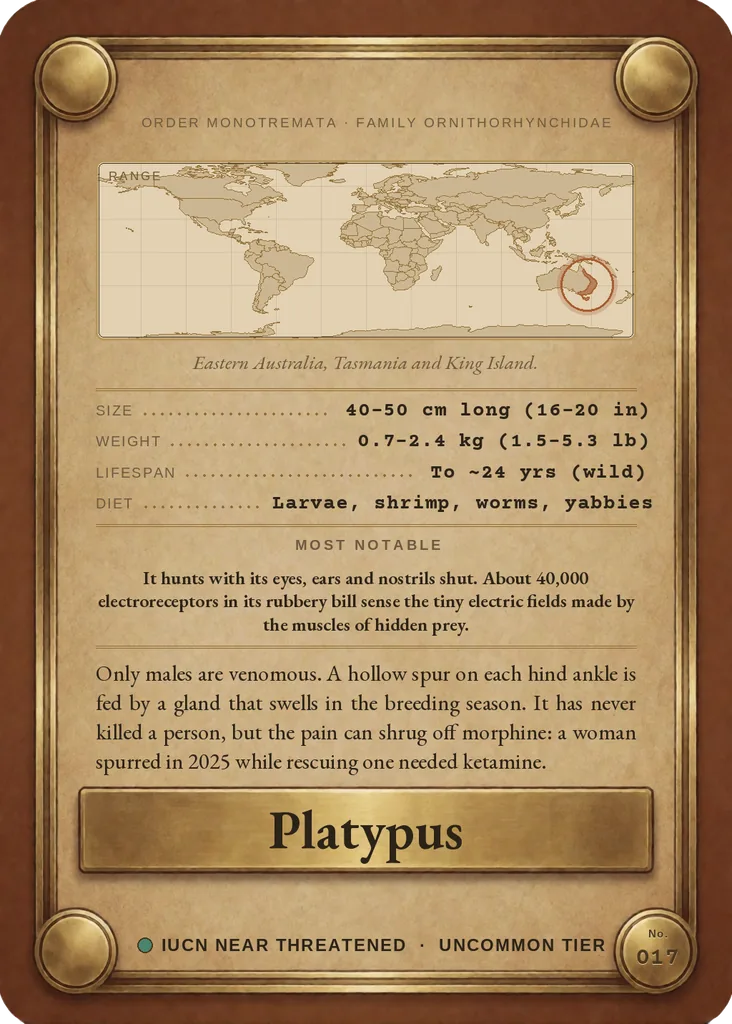
- Order Monotremata · Family Ornithorhynchidae
- Range
- Eastern Australia, Tasmania and King Island
- Size
- 40–50 cm long (16–20 in)
- Weight
- 0.7–2.4 kg (1.5–5.3 lb)
- Lifespan
- To ~24 yrs (wild)
- Diet
- Larvae, shrimp, worms, yabbies
Most Notable
It hunts with its eyes, ears and nostrils shut. About 40,000 electroreceptors in its rubbery bill sense the tiny electric fields made by the muscles of hidden prey.
Only males are venomous. A hollow spur on each hind ankle is fed by a gland that swells in the breeding season. It has never killed a person, but the pain can shrug off morphine: a woman spurred in 2025 while rescuing one needed ketamine.
Near Threatened is the global status. In Victoria the platypus has been listed Vulnerable since 2021, and in South Australia it is Endangered. It is still not listed nationally: a 2020 bid for Vulnerable status failed, partly because an animal this secretive is so hard to count.
It is one of only five living mammals that lay eggs, with the four species of echidna. A mother has no nipples; milk seeps from patches of skin on her belly and the young lap it from her fur.
Platypuses on the mainland of South Australia have not been seen since 1975. A population on Kangaroo Island was introduced in the 1920s and is not drawn on this map.
Range: Eastern Australia, Tasmania and King Island.